Wednesday, January 20, 2021

Digging into Psalm 23


Human beings seem to never be content. No matter how much they "have," they always seem to want more. You'd think that with all of the creature comforts and high standards of living that we enjoy, that we'd be contented. 

But we're not. We find evidence for this in our constant striving for more things and more money. People today never feel like they have enough money, yet they spend it constantly for the newest and most innovative, interesting things. How many people today are living on credit, because they simply MUST have this particular bauble? How many people, too, are living in conflict and stress because of human beings' insatiable lust for sex? How many people are just plain restless all the time? Even many believers are not content - we join unbelievers in lines at the bookstores and listen avidly to podcasts - seeking self-help and psychotherapy that promises to assuage our inner turmoil.

But I seem to recall in our study of II Peter, that God has provided us with everything pertaining to life and to godliness . . . 

for His divine power has granted to us everything pertaining to life and godliness, through the true knowledge of Him who called us by His own glory and excellence. (II Peter 1:3, NASB)

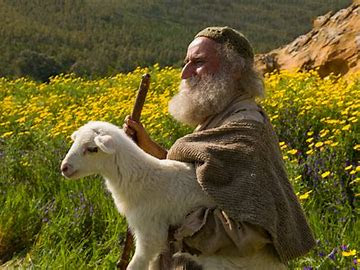
David, the shepherd-king, shows us in Psalm 23 the musings of a contented heart. Our relationship with God is compared to that of a contented, well-cared for sheep. It would have been a familiar analogy in David's day......but many of us have never "met" a sheep or a lamb outside of a petting zoo! It's lucky for us that so many pastors and preachers have studied and spoken and wrote about this psalm. Their consensus is that contentment comes from experiencing all that our Father God, our Good Shepherd, has provided for us.

I reckon it's pretty important -- that first step to contentment is right out there in the open. Easy to see:

The Lord is my shepherd; I shall not want. (Psalm 23:1, KJV)

The key to "not wanting" is to have the Lord as our Shepherd. Many people hear this at funerals. Or they hear it recited or as a responsive reading in church. It's very familiar; it's very soothing. But if we don't know the Lord as our personal Shepherd, it is also very meaningless. 

Do you feel I'm being too harsh?

Jesus made it clear that His being a Shepherd was not a blanket truth that applied to everyone. Not every person has Jesus Christ as his or her personal Shepherd. Remember when some of our Savior's opposition said, "If you are the Christ, tell us plainly"? Remember what Jesus told them?

 Jesus answered them, “I told you, and you do not believe. The works that I do in My Father’s name, they bear witness of Me. 26 But you do not believe, because you are not of My sheep, as I said to you. 27 My sheep hear My voice, and I know them, and they follow Me. 28 And I give them eternal life, and they shall never perish; neither shall anyone snatch them out of My hand. (John 10:25-28)

So, according to our Savior, the way to become one of His sheep is to hear His words, to understand them as verified in the things He did, and to believe by following Him.  Always at the core of what Jesus taught and did was the cross - where He took our penalty for our sins. Kinda makes sense that Psalm 23 follows Psalm 22, no? In Psalm 22, we studied our Messiah, forsaken of God as He bore the heavy weight of our sins on the cross.  It's only AFTER that that we read about the Lord being our kindly, caring Shepherd. We must believe in Him as our substitute, God's Son as sacrifice, before we can know Him as our Shepherd Who meets our every need. 

If we know the Savior of Psalm 22, and we trust in His death on the cross for us, and then we are seeking to follow Him, we can say with David, "The Lord, the covenant-keeper, the faithful God, is my Shepherd."

Phillip Keller, in his book, A Shepherd Looks at Psalm 23, tells of a shepherd who kept flocks next to his own. To say that the man was an indifferent shepherd would be to put it mildly. He showed no concern for his flock, and considered them to be just a bunch of dumb animals fit for slaughter. He didn't work on keeping his fields lush and growing, so that they would be well-fed -- in fact, this indifferent shepherd's fields were brown and impoverished, with insufficient shelter to protect them from storms, and with muddy, polluted water to drink. In their weak and sickly condition, they were easy prey for dogs, cougars, and rustlers. Phillip would often see them huddled in groups, staring blankly at the beautiful green pastures where he kept his own flocks. They are a picture of those who are in bondage to sin.

I heard once of a little girl who had tried to memorize Psalm 23:1 in Sunday School, but misquoted it as "The Lord is my Shepherd; I've got all I want."

Well, she actually got it right! If we have the Lord as our Good Shepherd, we can truly say, "I've got all I want." The first step to contentment is to know that the Lord Jesus Christ is our personal Shepherd.

Tuesday, January 19, 2021

Prayer requests


We are in a pickle here in the United States. Censorship is raising its head and coming for many of us with loud footsteps. It just may be that this blog gets the axe at some point soon. I've never pulled any punches. I've said what the Spirit of God nudged me to say; some of it has been politically incorrect. But until now, it has been protected by the First Amendment. 

However, the First Amendment is not a high priority at the moment in this country. 

Scary? Yes.

This culture war in America is first and foremost a war of words. And guess what? Evil is winning.

Google, Facebook, Twitter, and others are coming down hard on those who say things -- not things that are incorrect, but things they don't agree with. The old practice of intelligent and reasoned debate on our disagreements has given way to a cancel culture that simply wants to silence or destroy whoever holds a contrary opinion . . . . accusations of "triggering," "microaggressions," racism, and plenty of other "ism's" fly through the air and sully reputations. 
Whatever happened to Voltaire's "I disapprove of what you say but I will defend to the death your right to say it"?

Whatever happened to open discussion and persuasion?

In these Orwellian days, good is deemed bad, and bad is labeled good. If you are speaking quietly, it makes no difference. Even if you are quietly disagreeing, you are said to be shouting, mocking, ridiculing other individuals. You may even be accused of "hate" speech.

A recent Prager U video notes that we have a generation who is being raised not to value freedom OF speech, but freedom FROM speech. We are urged not to explore and discuss difficult topics in everyday life, college classes, and other situations, but to AVOID them! 

(Raising hand) Can I ask a question? 

How can I understand someone else's point of view if I never allow him or her to tell me about it? How can I learn, if I am constantly cocooned in things I know and agree with? 

(I know, I know. Rhetorical questions. The answer is obvious. It can't happen.)

Freedom of speech is broadly defined as having the right to express opinions without government restraint. It's an ideal whose beginnings date back to ancient Greece, and that has been cherished since the advent of the United States. Court case after court case, precedent after precedent, free speech has been protected. The common sense synopsis has been that even if I'm offended by what you say, it's ok for you to say it. With very few exceptions. Until today. 

And that is why I have broached this topic. I'm asking all of you to pray that "we the people" will wake up. That they will have some modicum of common sense. Somehow. 

Otherwise, this study blog, like so many other sources of good, will be snuffed out. We may try to open to study one morning and find it's been removed. Stamped out. 

“In those wretched countries where a man cannot call his tongue his own, he can scarce call anything his own. Whoever would overthrow the liberty of a nation must begin by subduing the freeness of speech...." Benjamin Franklin

My prayer request for today is that God will help us. That God will preserve His Word. That He will help us to be champions of His Word, and that we will have courage to do so. 

In the coming days, we may be sorely tested. God help us all.

Monday, January 18, 2021

Starting Psalm 23


This is another psalm that I approach with a careful, cautious tread. I don't want to rush in with stomping feet and get things wrong. There's so much here......so many brilliant scholars and Spirit-filled pastors have spoken and written on these words. What can I offer? I certainly can't offer anything new! But I can tell you what the Spirit has shown me as I studied these lovely, comforting, familiar-to-all-of-us words . . . .

I expect that for many of us, the King James translation was the first one that we heard this psalm from. For that reason, I've posted the KJV here, even though I may delve into other translations as we study:

The Lord is my shepherd; I shall not want.

He maketh me to lie down in green pastures: he leadeth me beside the still waters.

He restoreth my soul: he leadeth me in the paths of righteousness for his name's sake.

Yea, though I walk through the valley of the shadow of death, I will fear no evil: for thou art with me; thy rod and thy staff they comfort me.

Thou preparest a table before me in the presence of mine enemies: thou anointest my head with oil; my cup runneth over.

Surely goodness and mercy shall follow me all the days of my life: and I will dwell in the house of the Lord for ever.  (Psalm 23, KJV)

Do me (and yourself) a favor, won't you? 

Take time to re-read these verses today. 

Pray that God will guide our study in the coming days. 

The Lord will bless our studies and comfort our souls.

Thursday, January 14, 2021

Resting - reconciliation


We talked about how God rested to set an example for us - He rested after the work of creation. Jesus rested in the boat before His disciples awakened Him, in fear of the storm. Jesus also rested after completing the work of the cross . . . Remember His words?

And Jesus, crying out with a loud voice, said, “Father, INTO YOUR HANDS I ENTRUST MY SPIRIT.” And having said this, He died. (Luke 23:46)

Through our Savior's death, the work of salvation was finished - Jesus could enter the fullness of rest.

Therefore, while the promise of entering His rest still stands, let us be careful that none of you be deemed to have fallen short of it. For we also received the good news just as they did; but the message they heard was of no value to them, since they did not share the faith of those who comprehended it. ......There remains, then, a Sabbath rest for the people of God. For whoever enters God’s rest also rests from his own work, just as God did from His. Let us, therefore, make every effort to enter that rest, so that no one will fall by following the same pattern of disobedience. (Hebrews 4:1-2,9-11)

What is the rest that the writer of Hebrews is mentioning? He began his discussion of the rest in chapter 3, and referenced the Israelites wandering in the desert. God promised them the land of Canaan; He promised that He would go before them and defeat their enemies. He would make it possible for them to live in peace and security. 

What did they have to do? What was required of them? Simply to trust in God and His promises. 

But they refused to obey God, even murmured against Him and yearned to go back to Egypt! Because of their rebellion, it would be the next generation who placed their faith in God and entered the rest God had promised, in the Promised Land.

In chapter four of Hebrews, there's a more personal application of resting in God's promises. It's for us. Well, both to Hebrew and Gentile Christians! 

Therefore, since the promise of entering his rest still stands, let us be careful that none of you be found to have fallen short of it. (Hebrews 4:1, NIV)

The promise for us, the believers of today, is not that of entering the Promised Land, but of salvation through Jesus Christ. It is He Who can provide the eternal rest of salvation for our sins. God's rest is in the spiritual realm and faith is the key to entering it. The writer notes that the Hebrews had the gospel preached to them, but they did not combine hearing the message with the faith necessary to receive it...many of those who heard the good news rejected it for lack of faith.

Yes, resting in God is anchored in our salvation, through Jesus. Just as God rested from the completed work of creation, we can rest in the finished work of Jesus . . . what does this mean? Well, it means that we can rest from our empty efforts to earn our salvation. Our redemption does not come through OUR work, but from Jesus' work! And His salvation work is done!

True Sabbath rest is when we enter eternal life in the presence of God -- and since we have His presence beginning with our acceptance of His salvation, eternal life is now; it's already started! Look at these verses:

Now this is eternal life: that they know you, the only true God, and Jesus Christ, whom you have sent. (John 17:3)

 For my Father’s will is that everyone who looks to the Son and believes in him shall have eternal life, and I will raise them up at the last day. (John 6:40)

The passage in Hebrews makes it pretty clear that the Israelites didn't enter rest because they failed to believe. The book of Hebrews talks a lot about hardness of heart, and failure to believe. It's a call to everyone to believe in Jesus and be reconciled to God. This helps us to more fully understand Jesus' words:

“Come to me, all you who are weary and burdened, and I will give you rest. 29 Take my yoke upon you and learn from me, for I am gentle and humble in heart, and you will find rest for your souls. 30 For my yoke is easy and my burden is light." (Matthew 11:28-30)

And we have many verses and passages that assure us of our eternal rest. We are called to patient endurance, cheerful obedience, and determined faithfulness to our Savior.

Then I heard a voice from heaven say, “Write this: Blessed are the dead who die in the Lord from now on.”

“Yes,” says the Spirit, “they will rest from their labor, for their deeds will follow them.” (Revelation 14:13)

What does "rest from their labor" look like? We have a description:

Therefore,

“they are before the throne of God
    and serve him day and night in his temple;
and he who sits on the throne
    will shelter them with his presence.
16 ‘Never again will they hunger;
    never again will they thirst.
The sun will not beat down on them,’
    nor any scorching heat.
17 For the Lamb at the center of the throne
    will be their shepherd;
‘he will lead them to springs of living water.’
    ‘And God will wipe away every tear from their eyes.’” Revelation 7:15-17)

"Face to face with Christ my Savior, ......"

"I can only imagine....."

Old hymns or new songs, we believers long for the day when we enter the rest of our Savior. If we desire for our time on earth to be more restful, let's be faithful about making the seventh day a Sabbath day of rest. Let's listen to Jesus' offer, and go to Him and accept His gift of rest.

Wednesday, January 13, 2021

Resting, continued


Did you know that land needs rest? It's not just a concept for human bodies! And God established the idea:

Six years you shall sow your field, and six years you shall prune your vineyard, and gather in their yield; but in the seventh year there shall be a sabbath of complete rest for the land, a sabbath for the Lord: you shall not sow your field or prune your vineyard. You shall not reap the aftergrowth of your harvest or gather the grapes of your unpruned vine: it shall be a year of complete rest for the land.  (Leviticus 25:3-5)

Over the centuries, farmers have realized that the health of the land they work can become depleted. They've developed ways to restore the soil and its inhabitants. The term "lying fallow" is straight from the scripture:

but the seventh year you shall let it rest and lie fallow, so that the poor of your people may eat; and what they leave the wild animals may eat. You shall do the same with your vineyard, and with your olive orchard. (Exodus 23:11)

There are many plans to accomplish replenishment of the soil.  How many books have we seen that tout the advantages of organic gardening, amending the soil, adding earthworms, composting, and, and ...... whew! makes me tired just thinking of all the options! On a personal level, I try to use a lot of natural and organic strategies in my own garden -- I know that certain plants add certain advantages. For instance, bean plants add and "fix" nitrogen in the soil. Composting with shredded leaves and grass clippings makes the soil super-attractive to the neighborly earthworms who will helpfully make the soil more aerated, and less hard-packed. I even give certain areas of the garden a respite, and don't plant anything in them for a season (I'm blessed with lots of space), and just till the weeds under, then let it lie "fallow."  My efforts have been rewarded with garden space that is renewed and ready to grow oodles of veggies and flowers for me. 

There in Leviticus, the concept is there: the land needs rest. It is helpful for it to remain unplanted, and the Jews were to leave it thus every seventh year. During that year, they were not to worry about the lack of produce or shortage of food -- God promised that He would provide. Even in the time of (necessary) renewal of the land, God was teaching His people to trust Him.

Guess what!

What is true for the earth is true for us humans, as well. Our bodies and souls need rest. We read in Genesis that sin made work a burden -- so God gave us this Sabbath day as a gift to unburden ourselves from work. Jesus was challenged by the Pharisees many times; once He and His disciples picked some grain on the Sabbath. Oh, that lit the Pharisees' fuse! How did Jesus respond? "The Sabbath was made for man, not man for the Sabbath." I think we can translate that very simply . . . . God didn't create man so that He could look down on the earth and see that someone was observing a Sabbath. Instead, He created a Sabbath so that people could be rested and refreshed.

Did you know that more oxygen is expended by our bodies in a day of toiling and hard work, than what is recovered in a night of rest? Makes us wonder if we really can catch up!

I heard a story once of a wagon train to the West, whose people started out with high hopes and lots of faith. They stopped traveling every Sunday to rest the animals and the people. As winter approached, some in the group began to panic. Would they reach their destination before the snows came? It was a point of conflict in the wagon train, and so they split into two groups. One group was determined to travel seven days a week; the other group was going to travel six days a week.

Guess which group made it to Oregon first?

Yep, you're right! The group which rested on Sundays arrived first. The people and horses and oxen were so rested that they could travel much more efficiently on the other six days! 

The Sabbath was made for man. What can we do on the Sabbath day? Well, it's just my humble opinion, but I would think that Sunday is not the day to catch up on home repairs, paying bills, or running errands. I kinda think that part of our "tiredness" is that we used to work five days, have one day for all of that "gotta do" stuff, and then have Sunday to rest. Too often today we work six days and try to cram worship and catching up on that seventh day -- it's hardly a day of rest! I guess that anything other than work that delights and replenishes us is what we should do on Sunday. For some of us it will be spending time with family, relaxing together. Maybe it's reading a book, reading the Bible, doing a puzzle, or going for a swim or a walk. Perhaps it's extending God's mercy to those who are in a nursing home or housebound. Maybe it's taking a nap!

Sunday is a day for us to be creative and in addition to worship, find ways to renew our bodies and spirits. God doesn't want us to wear down. Or wear out. He has issued an invitation:

He says, “Be still, and know that I am God; (Psalm 46:10a)

And He promised renewal when He spoke through the prophet Isaiah:

but those who hope in the Lord
    will renew their strength.
They will soar on wings like eagles;
    they will run and not grow weary,
    they will walk and not be faint. (Isaiah 40:31)

Tuesday, January 12, 2021

Restful not restless


There are a LOT of self-help books and podcasts out there . . . people claiming to know just how you should live our lives. How to organize our closets. How to organize our whole house! How to have efficient cleaning days. How to cultivate good habits. How to have better sleep. How to have more friends. How to excel in the workplace. How to be less tired. How to have more energy.

How are our lives? Do we need more rest, more energy?
God established the concept of our lives being rest-full. 
He established a rhythm for our lives - balancing rest and work. We've said before that He had a purpose in establishing a Sabbath day . . . it was a day that (if we observe it properly) can provide us several types of rest.

Let's think about the children of Israel. We noted before that when they heard the commandment about the seventh day, their minds would return to the creation of the world; they would remember that God rested on the seventh day from the work of creation. 
And lest we think that our modern days are so different from the days of the Jewish nation . . . . yes, the children of Israel needed the reminder. They'd lived in Egypt for generations as slaves; they toiled as close to 24/7 as their supervisors could make it. They were treated as production machines. The idea of a seventh day rest was simply that; it was just an idea. It's practice was all but forgotten. But God did not intend for them to forget:
Remember that you were a slave in the land of Egypt, and the Lord your God brought you out from there with a mighty hand and an outstretched arm; therefore the Lord your God commanded you to keep the sabbath day. (Deuteronomy 5:15)
Are we any different today? Many people find it impossible to take a day to rest. They constantly carry their phones in their pockets or their hands. They are aware when text messages arrive; they know the instant that the email from that important client hits their inbox. They are always absorbed in working, working, working, just about 24/7.

The idea of resting on the seventh day was also presented to the children of Israel in the providing of manna. They were to gather manna on six days only - He promised that what they gathered on the sixth day would be sufficient for the day of rest. That day was a continuing gift to them. God promises us, too, that He will provide for our needs -- our food, our clothing, all that we need.

Since in the land they lived in, only they (Israel) treated the seventh day in this way, the concept of rest was also a sign to the rest of the nations that Israel was different. They were God's special people, and they belonged to Him. It was to be intentional. It was counter to the prevailing culture. And it will be so today, when we set aside a day to rest.  Many years later, Jesus would tell the Jewish people that the rest from work allowed for doing the work and ministry of the temple. (Check out the twelfth chapter of Matthew....) It can be a day for doing deeds of mercy and compassion. It can be a day of serving in ways that we do not serve during the rest of the week. It can be a day that we are intentional about extending God's mercy to others.

Oh! While we're at it, let's be clear about this: God did not designate Saturday or Sunday; He declared a seventh day. In fact, the word "sabbath" means intermission, or break. The Jewish people followed God's pattern by making the literal 7th day the Sabbath (Saturday). Christians moved it to Sunday, the first day of the week, in honor and celebration of the resurrection of Jesus. One "certain" day is not binding, but "a" day is. And when we understand that God did not rest because He was tired, but because He was satisfied that all was "good," we can understand how we should observe the rest day. 
God took time to enjoy what he had made.
So should we.
We enter into God's rest by enjoying and celebrating Him and what He has done for us. It's to be a day of worship and also one of celebration. God has brought us out of slavery to sin - into a life of grace. That's a real reason to worship God and celebrate His love for us! We can take a day to cease working and the world will go on without us just fine! God can be trusted to run the world without us. (Grin)
If you refrain from trampling the sabbath,
    from pursuing your own interests on my holy day;
if you call the sabbath a delight
    and the holy day of the Lord honorable;
if you honor it, not going your own ways,
    serving your own interests, or pursuing your own affairs;
 then you shall take delight in the Lord,
    and I will make you ride upon the heights of the earth;
I will feed you with the heritage of your ancestor Jacob,
    for the mouth of the Lord has spoken. (Isaiah 58:13-14)